
The ghost of loss gets into you
One month, five days, without my mom. The rest of them to go.

Most days I still think of calling my mother.
Today, for example, I imagine ringing her up, telling her I’m back at work on The Gauntlet, writing away. She always loved to hear that.
“Yes,” I’d tell her, “I’m writing about how devastated I’ve been since you died.”
My mom died on January 3, 2026.
A bunch of doctors gathered in the hallway outside her room to thank her for being an organ donor, reading a tribute written by my father. The doctors learned about her master’s degrees in math and music, and how she conducted our church choir for decades. They listened patiently as they learned she taught college and high school math classes for many years, how she took up painting after retirement, how she was a loving mother to two children: my brother Kevin, and me.
I was here in DC, still homebound, watching via Facetime on Kevin’s phone. A dear friend lay in bed with me while I sobbed, holding my hand. They removed all the life support. She breathed for one more hour.
Since January 3rd, I’ve read Crying in H Mart by Michelle Zauner, The Mercy Papers by Robin Romm, A Heart that Works by Robb Delaney, A Very Easy Death by Simone de Beauvoir, The Joy Luck Club by Amy Tan, and The Year of Magical Thinking by Joan Didion.
I guess I’ve approached grief the way I approached the pandemic: with a hunger for more information. Trying to understand is a coping mechanism. I think of those interviews with CEOs where they’re always bragging that, as kids, they’d take apart their toasters and VCRs, desperate to know how their electronics worked. Maybe I’m like that, but with tragedy.
I know much more about grief than I did a month ago. I know that I do not move through the “stages of grief” in a linear manner - denial, anger, bargaining, sadness, acceptance. Rather, I seem to experience each of them repeatedly, in an endless loop, ricocheting wildly between boiling rage and the snotty, wailing. convulsive sobs of a toddler (the latter loud enough to alarm my cat).
As far as stages of grief go, denial is my favorite. As times, I feel quietly certain that mom is, as always, at home in Pittsburgh, going about her day as I go about my day. I understand why denial is both typical and necessary as part of the grieving process. You simply cannot spend 24 hours a day fully aware of your loss. You must allow your brain to protect you from it at times.
But denial is fleeting, and as time goes on, it’s more difficult to dwell there. Denial curdles and mixes with bargaining, my least favorite flavor of grief.
Bargaining takes many forms.
I fantasize about the sort of daughter I’d be if my mom came back- a much better one, certainly. I’d start by heeding her requests to call every day, which I found to be over-bearing when she was alive. We usually spoke about once a week, sometimes every other week. When I was well, this was due to my busy schedule; after I got sick, it was due to my migraines and exhaustion.
Even on our last call, she repeated her common refrain as we were getting off the phone, “call any time,” to which I’d say, “I will,” to which she couldn’t resist adding, “you know, Jane’s kids call every day,” in a gentle teasing sort of way, Jane being one of her sisters. “Oh, well, we can’t all be Jane’s kids,” I’d always tease back.
These kinds of ideas- if you give my mom back, I’ll be a better daughter- aren’t uncommon, I learn. They’re pretty classic “bargaining”.
A friend of mine tells me that when her father was in the hospital last year, on his (so they thought) deathbed, she made all sorts of promises about becoming the perfect daughter should he only pull through. He lived. “And now,” she sighs, “I’m an evil daughter again.” I laugh. I find it oddly comforting.
There are other forms of bargaining. Imagining what you could’ve done differently to prevent the death of your loved one- that falls under the “bargaining” category too. And boy, do I do a lot of that.
My mother was suffering from Parkinson’s dementia. Although she’d only been diagnosed within the past year, she’d been declining over the past two years, losing her ability to participate in many of her favorite hobbies and daily activities like playing piano, painting, knitting, conducting the choir, driving and cooking.
But she still carried on relatively normal conversations with me, other than the occasional trouble with word finding or losing the thread of a thought. And as for her decline, to a degree I saw what I wanted to see. I wasn’t as worried as I should’ve been.
I hadn’t realized how dangerous day-to-day life was becoming for her. But on December 22, my dad informed my brother and I that my mom had fallen on the stairs. The following weeks were harrowing, with bad news following bad news. She never left the ICU.
My parents had been talking about moving into assisted living- why hadn’t I urged them to move faster?
My mom mentioned to me that she had had a fall recently- why didn’t I ask for more information? I told her to get a cane, and she had responded “oh, I don’t think it’s time for that yet,” while laughing. I replied, “mom, I have a cane, and I’m 39!” Why didn’t I press the issue? Why wasn’t I more worried about her mobility?
I literally write about disability for a living, and it didn’t occur to me to ask about the mobility modifications at our house?
All these thoughts occur and reoccur to me, swirling, chaotic, while the fact of her fall remains, stubborn and unchanging: December 22. Three days before Christmas. Three days before her birthday. (Yes, her birthday was Christmas Day). The day before my brother was driving home for a visit.
And what about the random chance of it all? What if I’d called her the morning of her fall? What if I’d called her right before she’d walked upstairs to look for whatever she’d gone upstairs to get? My dad said they’d been getting ready to go to an eye doctor appointment, but that the appointment had been rescheduled from an earlier date. What if that appointment had never been rescheduled? What if, what if, what if?
I sometimes believe that my mother is going to text me, and as long as I am good and do not mention this whole “falling down the stairs-catastrophic brain bleed” ordeal everything will revert to normal. She will ask me how my day was, and I will say I had a bit of a headache, and we will move on from there. It will be like an alternate universe sort of arrangement, and I won’t complain, which is the price of admission.
This too, is bargaining. I’ll do my part universe. I won’t question. I won’t complain. You do your part. Bring her back.
I felt badly about these kinds of wild ideas until I read Didion’s book, where she describes exactly these sorts of strange, “magical” thoughts, refusing to give away her beloved dead husband John Dunne’s shoes because he may need them “when he comes back.”
Sometimes I speak aloud to my mom. A friend, who is Iraqi, assured me that “in some cultures it would be weird not to do that.” I appreciate that the more I learn about grieving, the more I receive the message that there’s simply no right, wrong, or too-weird way to do it.
I will say that I seem to have moved beyond my initial impulse to constantly talk about “bringing mom back,” which I know discomfited my brother after about the 7th time I mentioned it. But I couldn’t help myself. It’s simply how I felt and it kept slipping past my tongue. “Does anyone have any ideas about bringing her back?”
Something about being so close to her in time made me feel like it wasn’t impossible to undo her fall, her accident, to somehow reverse what happened. As more time goes by, this feeling fades, though not entirely as of yet.
Maybe I’ve watched too many movies where characters slide seamlessly into alternate universes, travel through time back to critical moments, undo something that mustn’t have happened, fly around the world backwards until something terrible never was.
A few weeks before she died, my mom texted me about my then-newest article on the Gauntlet, Uneasy Peace, marking 2 years of living with Long COVID, and over a year of being totally homebound. It is the last article of mine mom ever read.
She wrote “well, your latest article is heartbreaking and beautiful and wise”. I wrote back, “thank you mom!”
She responded, “A friend thanked me today for recommending the book All the Beauty in the World to her. She had finally read it after three years. It somehow seems similar to your article so I’m going to read it again.”
“Haven’t read it!” I said. “Maybe I should check it out?”
“For sure!” she advised. “It’s about a go-getter, whose life changes when his brother dies.”
Those are some of the last texts we ever exchanged.
I find it strange, but also comforting, that my mother recommended a book about grief to me just before she died. It is a little life-preserver I grab onto in the vast sea of motherlessness where I now find myself drifting.
All the Beauty in the World follows a man who, after the death of his brother, leaves his upwardly mobile job at The New Yorker and gets a position as a security guard at the Met. For ten years he walks the halls of the museum, living life at a slower pace, finding solace in the galleries.
It’s easy for me to see why she liked the book. She loved the Met. She loved New York. She loved art. I find myself reading the book not only as myself but also through her eyes- registering what she’d have enjoyed. It makes me feel close to her.
My mother was not religious, not spiritual. She loved opera, the theater, the symphony, she played piano and guitar, she sang, she painted, she quilted, she dragged me to every art museum. While I’d speed through, she’d lag behind, reading every tiny little placard and seemingly absorbing every tiny little brushstroke.
Like the author, art is where mom found her solace, and where it seems she’s encouraging me to find mine. In my own art, in her art, in all art; in all the beauty in the world. In expressions of grief, fellowship, joy and love that have survived centuries, and been appreciated across generations. In my work, my writing. In her paintings. In music and books that express what I cannot possibly.
In the words of others who somehow know already, better than I, what I am feeling.
The last painting she ever completed was of my beloved cat, Beatrice. She didn’t want to finish it because her symptoms were worsening, and she didn’t feel it was up to her usual standards. I’m so glad she did. Last April, she showed my brother and I the finished painting over Zoom, and last July, during her final visit to my apartment in DC, she brought me the painting in a frame.
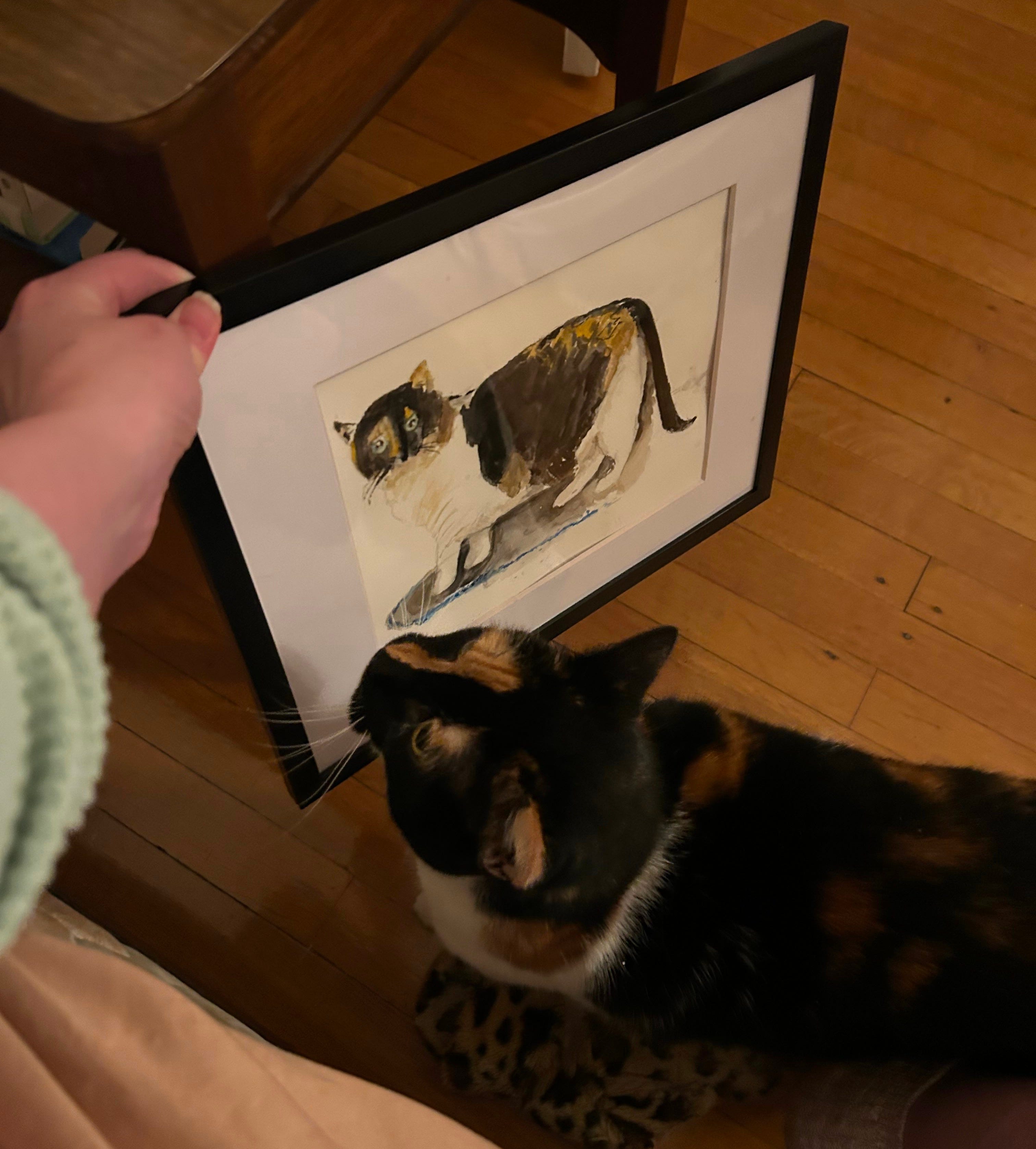
I have another painting of hers. It’s a gorgeous painting of a greenhouse, which she completed while she was perfectly healthy. But the one I look at and cry every night is the painting of Beatrice. The painting she finished when she was sick, and struggling, and questioning whether it was really any good. The painting she gave me the last time she saw me, the last time she ever saw me.
I have a good friend who lost his father in a tragic accident about five years ago, who’s been a great support to me during this time. He sent me a poem which he found comforting during early mourning. The poem, called For Grief is by an Irish poet, John O’Donahue.
I loved the poem, and sent For Grief on to my dad and brother.
My dad replied, “That’s the same author who wrote the blessing your mother photographed in her last days and which I read at the end of the service!”
Sorry- what??
I asked him to clarify- why had mom photographed the O’Donahue blessing, which was sitting in her desk, in her last days?
My dad doesn’t know.
Here’s the blessing, which was one of the final photos in my mother’s phone, followed by one of the Christmas tree and a few of the dog.
Beannacht / Blessing
On the day when
the weight deadens
on your shoulders
and you stumble,
may the clay dance
to balance you.And when your eyes
freeze behind
the grey window
and the ghost of loss
gets into you,
may a flock of colours,
indigo, red, green
and azure blue,
come to awaken in you
a meadow of delight.When the canvas frays
in the currach of thought
and a stain of ocean
blackens beneath you,
may there come across the waters
a path of yellow moonlight
to bring you safely home.May the nourishment of the earth be yours,
may the clarity of light be yours,
may the fluency of the ocean be yours,
may the protection of the ancestors be yours.And so may a slow
wind work these words
of love around you,
an invisible cloak
to mind your life.
I am, like my mom, an agnostic. I don’t believe in any organized religion, and I’m not particularly spiritual, aside from thinking the laws of physics are pretty gnarly and pretty cool. But I’m going to choose to think of this as a last message from my mom, because it was on her mind, because she loved us, because she wasn’t able to say goodbye the way she’d have wanted to, because I know she wishes she could comfort us now.
You spent my whole life working these words of love around me, mom. You are the invisible cloak that minds my life. You will never be gone. You will never be gone.
Thank you, Julia. Many of my friends and family think I'm nuts for remaining masked and avoiding crowds and unventilated spaces so long after they have decided the pandemic is "over." I say I have a friend with Long Covid who has inspired me to avoid it at all costs. That friend is you, Julia. Thank you.
My deepest condolences, Julia. The profound loss of our mother impacts our lives beyond words, yet you managed to articulate the depths of your grief in a beautiful poetic manner. Thank you, for sharing your raw brokenness. Hugs to you. The painting, her painting, a treasure…now an heirloom. Her love lives. ✨ The grief poem wrapped my spirit in comfort as I just lost my sister 3 wks ago to a devastating cancer that ravaged her quickly. During the coldest and most extreme Midwest winter of my lifetime, the bitter harsh weather is a metaphor to the gripping isolation of grieving tethering my soul. Please take care of yourself during this delicate period in your life. The emotional stress and depths of grief manifest hard in physical depletion. We’re here when you are able to share. ❤️🩹